12/29/11

Bluebeard - Points of view.


In the 1697 story ‘Bluebeard’, written by Charles Perrault, a story is painted of a very wealthy man that is considered terribly ugly because of his blue beard. He was so ugly and frightening women would actually run from him. In addition to his horrible looks there were rumors that he had been married many times previous, and nobody knew what had happened to his wives.

He desired one of his neighbor’s two beautiful daughters, but neither wanted him. To win affection he threw a party at his home and had several girls over for a week of all kinds of fun. His efforts were not in vain as the youngest of the girls began to see him differently. They were soon married and shortly after Bluebeard was called away for a trip.

He gave his new bride free reign of the house, handing her keys to everything and granting her permission to go anywhere, except for one closet. She promised and he went away. She then quickly threw a large party while he was gone and became very curious about the forbidden closet. She opened it and found it full of dead women.

Bluebeard, returned home and found out what happened he set out to kill her. She was granted a short bit of time before she was to be slain, in which she contacted her brothers who came and killed Bluebeard seconds before he was going to slay his disobedient wife.

While the morals written by Charles Perrault talk about regret from entertaining curiosity and perusing disobedience, the article written by Ginette Vincendeau reflects much deeper ideas and interpretations. He admits that there is the aspect of addressing the caution against curiosity, but he also goes much deeper, even to suggest, “It is a parable on the dangers of sex for girls” (Vincedeau, 2010).

Another aspect he suggests is that it is a glimpse of the story of Eve’s disobedience in the Garden of Eden. Consider how she had free reign of the garden, and was only instructed not to eat from one tree. This is a great parallel, until we see the girl’s brothers kill Bluebeard. If Bluebeard were personifying the role of God, the comparison does not really work.

He also discusses that others have a view of the story showing a close relationship to that of a victim and their assassin, the sexual power struggle of men against the emerging sexuality of females and even a relationship to death in childbirth.

Regardless of the message the underlying story is terrifying. Women identify with the joy and freedom the new bride experiences with the sharp contrast of fear as she realizes whom she is really married to. We could consider the simple phrase, “ignorance is bliss”, as she was happy until she knew the truth. The truth is the women were killed previous to her developing the relationship. The only thing that had changed was her perspective. And that is what this story is really about, perspective.


Works Cited:

Perrault, Charles. “Blue Beard.” Contemania.com - Contes, Fables, Histoires, Comptines - Texte Intégral Gratuit. Web. 12 Nov. 2011. .

Vincendeau, Ginette. "Bluebeard." Sight & Sound Aug. 2010: 50-51. Wilson Web. Web. 12 Nov. 2011.

Serious, Nonsense, the Best of Both.

Defining children’s literature may seem like a simple task when the thoughts of picture books, phonics builders, fairytales, and the like at a primitive comprehensive reading level. Children’s literature seems to really boil down into two main categories. Children’s stories have always been used to help teach, educate, train and even entertain children with fundamental principles that will help move them forward in their culture. As stories have evolved through the ages, we see the extremes of structured principles, nonsense and an approach that shows a balance of both extremes.
Aesop’s fables, while rather simple short stories, were entertaining illustrations for teaching principles. Consider these allegorical writings with their simple lessons. We see these simple teachings in fables like; The Crow and the Pitcher, and learning the principle of innovation; The Fox and the Grapes, which gives insight to dealing with disappointments; and the classic lesson of “Slow but steady wins the race” in The Hare and the Tortoise (Aesop, 2007). The fables are short entertaining and give children a unique life lesson. These stories also show fundamental characteristics in the characters in each story. Consider the fast hare, or slow tortoise. The stories also were more geared around the outcome or lesson for the audience. The more serious, and lessons of cause and effect in many cases revealed disappointment for the characters developed.          
A completely different approach with children’s literature would be The Owl and the Pussy-cat, by Edward Lear. While some may question Lear’s value in pushing fundamental principles in culture, he may have actually touched on one of the most important values children need to consider. He has earned the title, “an unrivaled master of nonsense verse” (Stahl, 2007). Lear revels the value of fun, silliness and wonder that often is discouraged in childhood. He helps remind kids to be kids and not grow up too fast. His stories of nonsense that talk about a women with a long “wonderful nose”, or the man with all kinds of birds nesting in his beard, and the owl and the Pussy-cat went to sea In a beautiful pea-green boat,” create more of a dreamlike story where anything is possible (Lear, 2007).  Silly rhymes and concepts paint a creative picture in the minds of his audience as he fills their thoughts with silly creative images.
Shel Silverstein takes the principles of both lesson, and nonsense then unifies them in a very unique piece called; Sarah Cynthia Sylvia Stout Would Not Take the Garbage Out. This ingenious fusion of the entertaining foolishness that children love, and the very simple moral or lesson, is a great merging of the two approaches. I enjoy most the climax of the story where the character finally says, “ ‘OK, I’ll take the garbage out!’ But the of course it was too late… The garbage reached across the state,” (Silverstein, 2007). The phrase paints a very vivid image and is so witty in the rhyme scheme that it just makes one smile. The story builds so nice and the lesson is clear as day, don’t procrastinate.
Children’s literature is most difficult to break down into categories with its many avenues, themes, styles, reading levels and so on. The evolving art of writing children’s literature has does have two drastically different approaches used to reflect the values of its culture. We see in early works like Aesop’s Fables that while the entertaining factor was present that the lesson was serious giving opportunity for many different avenues of application. As time moves forward culture saw the value in fun foolish gibberish in many of the creative silly tales of Edward Lear. Both have value and both are still valid approaches seen in children’s literature today. But we also see how well these two approaches work when they are fused together like in the stories written by Shel Silverstein. Keeping things light, silly and entertain, and yet giving children a simple lesson makes shows the influence of two great approaches.

Works Cited:

Aesop. "Aesop's Fables." Crosscurrents of Children's Literature: An Anthology of Texts and Criticism. 1st ed. New York: Oxford UP, 2007. 335-36. Print.
Lear, Edward. "Edward Lear (1812-88)." Crosscurrents of Children's Literature: An Anthology of Texts and Criticism. 1st ed. New York: Oxford UP, 2007. 312-13. Print.
Silverstein, Shel. "Shel Silverstein (1932-99)." Crosscurrents of Children's Literature: An Anthology of Texts and Criticism. 1st ed. New York: Oxford UP, 2007. 316. Print.
Stahl, J. D., Tina L. Hanlon, and Elizabeth Lennox Keyser. Crosscurrents of Children's Literature: an Anthology of Texts and Criticism. New York: Oxford UP, 2007. Print.

Achieving Authenticity in Childrens Literature


DISCUSS TOPIC:
Authenticity of voice is often a topic analyzed in literature. Considering key elements of the character’s identity, such as race, class, gender, or regionalism, how can a writer portray characters which are different from the writer’s own and still achieve authenticity?
 

While there is a great bit of children’s literature that is story telling, many pieces involve an author placing themselves in different roles in the characters of their stories. The writer of today is called to address many topics and issues that they may never have experienced personally. Consider the topics of abuse, divorce, sexuality, and social issues children of today face. Consider how many others use personification and take on the character of an animal. Taking this even a step further an author may develop characters that come from a completely different background then their own. In considering the contrast of race, gender, wealth, and even culture and geological location, many might question how the author keeps the character believable and well developed.

A key component involved in a genuine character for any author would be research. The author need to delved into the situation, life, culture, values, and find as many characteristics to build and develop an authentic character. This is much easier today than many years ago with the convince of technology, and travel. The world that was once so vast keeps getting smaller and smaller with people traveling and visiting all over. Developing a realistic character not only provides authentic characterization for the reader, but also reaffirms and educates the reader about other issues they might not be as familiar with.

Once an author has found several key examples to pattern a character from they then need to delve in with empathy. They need to consider their background, heritage, hurts, joys and what has shaped them into the character they are. With empathy and careful consideration the character will be understood by the author who can then develop an authentic character that is contrary to their won life experience.


Resources:
AIO Classroom, Children's Literature | ENG4010 P01. Week 3, Web. 19 November 2011.


Childrens Literature Non-Fiction

Non-fiction children’s literature is produced in several different formats. From very simple picture books, watered down reproductions of classic documents, how-to manuals and even expository text, children’s non-fiction literature encompasses a very large variety of topics. In reviewing many different books about animals, history and architecture, to very simple concepts like shapes and colors. These non-fiction children’s books bring information to children in a format that children can be drawn in and digest.
With such a large variety of texts in this genre, this paper will specifically look at the category of animals and examine and contrast the different reading levels and content provided by several popular publishers. It is apparent that some publishers are better than others as they provide an over all better product with greater aesthetic appeal. As society moves forward we see new and innovative publishers taking the place of those we at one time considered to have the corner of their market.
  With children’s literature targeting a wide range of reading levels one of the main things I found in my research is that there is a wide range of books available. In discussing this with the librarian she pointed out that children start pulling these books out for book reports as early as second grade. Some children need simple facts, while older children are looking for greater details. Even beyond research some children are drawn to certain animals and earnestly research for their own recreation. With this in mind I found a wide range of books in the category.
A Scholastic book, by Ann O. Squire, “A True Book Tigers”, seemed to be more of a middle ground compared to the other books in this section. The photography was not as clear, and the books design allowed for smaller photos and larger sections of text. The design and color scheme seemed a bit dated as well and did not make book exceptionally appealing when compared to others in its section. Other books that fell in this group were Xavier Niz’s, “Elephants”, and even “Hippopotamus” by Patricia Whitehouse. Whitehouse took a slightly different approach as they pose questions at the beginning of each section and used the text to answer the question. Questions like, “What do hippos look like?”, “Where do hippos live?”, and “How are hippos special?” are covered in this book (Whitehouse, 2003).
Other books like “Amazing Animals Orangutans”, seems to have more information begin to prepare the reader for digesting more text and content about the topic. This book chooses to use nice large photos to relate to the text, but other books like Gorillas, by Gail Gibbons use a more illustrative approach. Gibbons book is full of loose watercolor and ink illustrations, yet has many facts that you would not expect to find in a more expressive piece like, “Gorillas never use a newt more than once”, and “Gorillas rarely drink water because of the plants they eat are juicy” (Gibbons, 2010).
The Pebble Plus books appear to have a superior aesthetic to the others.  In reviewing the “Manatees” book by Jody Rake and “Giraffes”, by Catherine Ipcizade I was exceptionally impressed. Considering the elements of large vibrant photographs, simple yet informative text, and consistent format, the young readers are given a clean and informative experience. The wealth of information, is well-organized, very easy follow and to understand. 
With children’s non-fiction literature, the options seem endless. One of the great ways to sift threw the many texts and find the exceptional pieces are identifying publisher series. I personally was most impressed with the Pebble Plus publications as they were so well done. The consistency from one book to the next was also very reassuring.  Even in comparing well-known publications like Scholastic, Pebble Plus just seemed to be more direct. I believe this is partly in part to they way this genera has evolved. Pebble Plus is more of an up and coming publisher while Scholastic was more popular when I was a child. We see the progression and how the new publishers have a fresh and contemporary piece. As non-fiction literature moves forward I believe we will continue to see the content to be more concise and the photograph quality continue to improve.


Works Cited:

Gibbons, Gail. Gorillas. New York: Holiday House, 2010. Print.

Ipcizade, Catherine. Giraffes. Mankato, MN: Capstone, 2008. Print.

Kueffner, Sue. Orangutans. Pleasantville, NY: Gareth Stevens Pub., 2009. Print.

Niz, Xavier. Elephants. Mankato, MN: Capstone, 2005. Print.

Rabe, Tish, and Jim Durk. Is a Camel a Mammal? New York: Random House, 1998. Print.

Rake, Jody Sullivan. Manatees. Mankato, MN: Capstone, 2007. Print.

Squire, Ann. Tigers. New York: Children's, 2005. Print.

Whitehouse, Patricia. Hippopotamus. Chicago, IL: Heinemann Library, 2003. Print.

What About Young Adult Literature?


A plethora of options for reading seems to have always existed for both children and adults alike. The large children’s section of libraries and bookstore are filled with picture books for the emerging readers. The adult section filled with its fiction, self-help, biographies, autobiographies, and other non-fiction texts seem to be the grander part of every bookstore or library. Where does literature for young adults fit in between the childish and mature? “Young adult literature is often thought of as a great abyss between the wonderfully exciting and engaging materials for children and those for adults” (Vandergrift, 2011).

Pre-teens have it pretty rough. They are going through so many changes so quickly. In addition finding literature that is interesting enough, and digestible for their reading level. Young adults want to find text that engages them at their crossroads in life. They want a read that reflects their hopes, dreams and struggles in life. Today’s growth in adult literature “not only their needs but also their interests, the literature becomes a powerful inducement for them to read, another compelling reason to value it, especially at a time when adolescent literacy has become a critically important issue” (Cart, 2008).

Building a large selection of literary pieces for this group helps address the motivational issue of getting young adults to make reading a priority. It then, “provides a medium through which adolescents and their teachers can raise "hot topics," and confront and grapple with the social contradictions and complexities that comprise adolescents' lives” (Groenke, 2011).

Today’s teens have a much better selection than those seeking this scope of literature 20 years ago. Today, “a wealth of fiction created especially for teens that deals with the possibilities and problems of contemporary life as experienced by this age group” (Vandergrift, 2011). This not only has given this group more options for recreational reading, but greater opportunity for self-discovery. “Through story a reader can confirm one's own life experiences” (Vandergrift, 2011). In being a bystander witnessing characters deal with life issues, emotions, and situations, young readers gain great insight in healthy and appropriate responses to their daily issues as well. “This tension is evident in everyday life but revealed most fully in story” (Vandergrift, 2011). By offering a greater base of options to this young adult target group, society is not only providing engaging literature, but also providing an opportunity for maturity and self-discovery.

Works Cited:

Cart, Michael. "The Value of Young Adult Literature | Young Adult Library Services Association (YALSA)." ALA | Home - American Library Association. Jan. 2008. Web. 26 Nov. 2011. .

Groenke, Susan, Joellen Maples, and Jill Henderson. "Raising "Hot Topics" through Young Adult Literature." Voices from the Middle 17 (2010): 29-26. Web. 26 Nov. 2011.

Vandergrift, Kay E. "Vandergrift's YA Literature Page." Home - School of Communication and Information - Rutgers University. Web. 26 Nov. 2011. .

Alexander and The Terrible, Horrible, No Good, Very Bad Day...


Favorite Picture Book and Other Matters of Aesthetics
One of my all-time favorite books is a complete masterpiece by Judith Viorst and Ray Cruz. The duo of Viorst writer and Cruz illustrator in, Alexander and the Terrible, Horrible, No Good, Very Bad Day, has always been a favorite of mine. The team of writer and illustrator were able to really find common ground in the storytelling and creating very convincing imagery.  The book and its text and illustrations work hand in hand to express a very entertaining and engaging story.
This incredible story details a disheartening day of a young boy name, Alexander.  His day is an account of hi one problem and disappointment after another. It has always been a fun read for me as a child and adult alike. I found as a child, I was able to identify how the little things that happened in the day would pile up and make the whole day seem bad. As an adult I can identify with the “When it rains it pours” complex we get into as people and love the expressions that the illustrator has created for Alexander. Ray Cruz must have had many children he referenced as he was working on this piece, as his illustrations are spot on. 
The book not only is very accurate in the perspective of a young boy may have, the illustrations are very expressive as well. The illustrator has chose to work in a black pen and use hatching and some pointillism to create detail and shadow in the imagery. While some might find the lack of color disappointing, I think it is another element to push the dynamic of the book as each vignette has rich detail of texture, and adds to the dramatic expressions of the character. The images are incredibly detailed and show very accurate gestures and expressions that go hand in hand with the storyline.
In my opinion one of the best lines from the book is toward the end where Alexander comments on dinner then the kissing he saw on TV. The simple phrasing any young boy can identify with, and every parent has heard. Then the complement of the illustration is priceless. The wild hair created for the character adds to the overall look and characterization of Alexander. Both the text and illustration work hand in hand to say a big “YUCK” with out spelling the word out.
While some might say the book is overall a little negative, I find it to an extreme that makes it humorous. I believe this is the overall idea that the author had in mind. They wanted to show a child having a bad day and show us how to laugh at these little things that might bug us. The closing of the story wraps up the concept with “My mom says some days are like that” and gives the story grounding that we all have bad days (Viorst, 1987). Together the team of Viorst and Cruz address this issue of a bad day and create fun and entertaining book that we can all relate to.
Works Cited:
AIO Classroom, Children's Literature | ENG4010 P01. Week 1-4, Web. 28 November 2011.
Viorst, Judith, and Ray Cruz. Alexander and the Terrible, Horrible, No Good, Very Bad Day. New York: Aladdin

Banning & Censoring Children's Literature


DISCUSS TOPIC:
Banning and censorship in children's literature.

Banning and censorship of children’s literature directly comes from the Library Bill of Rights, Article 3 that states, “Libraries should challenge censorship in the fulfillment of their responsibilities to provide information and enlightenment” (ALA Library Bill of Rights, 2011). While many individuals, like myself, would think the number of books challenged each year would be rather minimal, I was shocked to learn that “There are hundreds of challenges to books in schools and libraries in the United States every year” (Kennedy, 2011). “According to the American Library Association, there were 348 challenges reported to the Office of Intellectual Freedom in 2010, and many more go unreported” (Banned Book Week, 2011).

Challenging or banning a text does not vanquish the piece from existence. It is simply is an effort to put some restriction on the access of the piece and possibly remove it from the library or educational syllabus.

The book I was most shocked to find in the top challenged titles from 2010 was, Twilight (series), by Stephanie Meyer. Knowing the great popularity of the Twilight (series) and how it is even greatly increased with the release of the movies, I was shocked to see this saga in a list of challenged texts. The reasons listed, “sexually explicit, religious viewpoint, violence, unsuited to age group” seem a bit extreme in my opinion (Banned Book Week, 2011). I was surprised that there was not an issue with the vampire aspect but more an issue of the inappropriate connection of the characters, and mostly was considered sexually explicit. In my opinion the series should not be under such scrutiny. The setting is high school and the audience appears to be for a mature teen. Maybe 50 years ago this type of stories and relationships were more frowned upon. But today it seems more commonplace. I am not advocating that the decay of society is good, but rather where it is.

In my opinion, parents really need to step in here. Most parents screen movies, why would they not screen their Childs literature. I would imagine most kids hear way worse things on the playground or bus ride to school. I am reminded of a friend of mine that has a 4 year old that reads. My friend mentioned that he must be careful what magazines and books he leaves lying around his home, as his young son reads everything. There are some things a child should not read. This once again is the parent’s responsibility to protect the­­ child.


Works Cited:

"ALA Library Bill of Rights." ALA Home - American Library Association. Web. 01 Dec. 2011. .

Banned Books Week. Web. 01 Dec. 2011. .

Kennedy, Elizabeth. "Censorship and Banned Children's Books and Books for Teens." Children's Books - Reviews Articles Lists of Best Children's Books. Web. 01 Dec. 2011. .

Raising Standards & Expectations with the Caldecott Awa


The Caldecott Award Pushes Picture Books Further

Picture books are very enjoyable for readers of all ages. While they may be the first favorite books of young toddlers, they still can be found on the coffee table of even the most educated and refined individual. The stunning creativity and expressive strokes that tell such an elaborate story with such little use of words is most impressive. The Caldecott Award has been a huge part of children’s literature since 1938. It originated in honor of “Randolph Caldecott, a nineteenth century English illustrator who was known for his picture book illustrations,” (Kennedy, 2011). Today it is awarded annually to children’s book illustrators for the original, and very distinguished work in children’s literature. One key element of the award is the aspect of “advancing the story visually” (Miller, 2011).  This award has established an expectation and standard to ensure the quality, detail and expressive creativity in the development of children’s literature.  
source: http://mwhittrandr.blogspot.com/2011/05/jumanji.html
Looking back to the 1982 Caldecott winner, Jumanji, by Chris Van Allsburg rich detail is revealed in elaborately detailed scenes.  The many unique perspectives and incredible use of value make this book truly a magnificently illustrated piece. Also consider how the artist was able to create such realistic and dramatic images with a limited color palette. The details of the setting and the characters are so subtle but tell the story of wonder, surprise, and curiosity that the story holds.   
Source: http://www.childlit.com/battledore/shop/index.php?productID=160
Van Allsburg again produces another magnificent piece that was awarded in 1986, The Polar Express. Like Jumanji, The Polar Express also shows realistic detail creating a very dramatic visual story. A difference in the two pieces is that in The Polar Express we see rich color, but both pieces hold a realistic detail that is very similar. “Van Allsburg's beautiful illustrations become as important to the story as the words themselves” (Caldecott Medal Picture  Books, 2011).
 Source: http://coxsoft.blogspot.com/2007_12_01_archive.html
Beyond just visually appealing artwork, Van Allsburg has visually told the story. “These life-like pictures encourage children of ALL ages to explore their own imaginations and to become active participants in the young boy's journey” (Caldecott Medal Picture Books, 2011).
Source: http://picturebookjunkie.wordpress.com/2011/06/08/hello-world/
            The Caldecott is not only for detailed realistic illustrations, but also is awarded for other visual aesthetics that enhance the story. Smoky Night by Eve Bunting is a sharp contrast to the awarded pieces of Van Allsburg. The acrylic painted illustrations on top of the photographed collage of story related items creates a dynamic rich texture that drives the story forward. The texture in turn relates directly to the story like, “when in the story the boy views people stealing cereal from the market, the background is a photograph of actual cereal” (Caldecott Medal Picture Books, 2011). Bunting shows us that creativity and innovative thinking are also key elements admired by the Caldecott Metal. Her book was awarded in 1995.

 Source: http://www.betterworldbooks.com/golem-id-0395726182.aspx
            Even techniques like hand cut paper have been recognized as they have proved to be a great medium for illustration. Golem, by David Wisniewski, was a medal recipient in 1997. “It's beautiful, with cut-paper illustrations that seem to spring off the page” (Caldecott Medal Picture Books, 2011).  At the same time, the choice of color equally added to the dynamic, which adds to the grim tone and development of the story. With this in mind, this book would be considered for a more mature audience as it addresses the Jewish persecution in 1580. The tone and content would not be appropriate for young children. 
 Source: http://alotlikebreathing.blogspot.com/2010/09/house-in-night.html
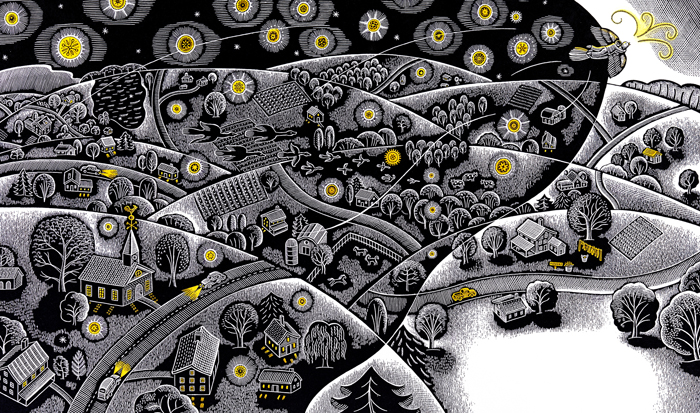
            Another masterpiece that won the Caldecott Award in 2009 is The House in the Night by Susan Marie Swanson, and illustrations by Beth Krommes. This book is truly a visual experience. The artwork is done in a limited palette just using the page color and black ink with splashes of yellow color. Still another illustration technique is used in this piece as well. The etching style of illustration is a completely different style than the previous 4 awarded books. The artist uses hatching techniques to create rather involved landscapes with a rather long visual field considering the technique. A very small sentence or phrase on the page guides the reader as they gaze at the elaborate monochromatic texture before them. Consider the complex illustration below where the text simply reads, “the house in the night” (Swanson, 2008).
Source: http://blaine.org/sevenimpossiblethings/?p=2206
With imagery as such a key element in picture book literature, we can appreciate the standards that the Caldecott Medal recognizes and ensures in children's literature. The award proves that the expectation and standard remain paramount in quality pieces for children’s literature. At the same time we also see that the Caldecott is not in any way committing to one style of illustration over another, but rather celebrating creative and progressive works that directly correlate with the story line and push the message of the text forward. The Caldecott Award proves that the creativity and expression created should not go unnoticed as it recognizes the efforts of dedicated authors and illustrators in this industry.

Works Cited:
Bunting, Eve, and David Diaz. Smoky Night. San Diego: Harcourt Brace,
      1994. Print.
Caldecott Medal Picture Books. Web. 03 Dec. 2011.       
      medal-picture-books.blogspot.com/>.
Kennedy, Elizabeth. Caldecott Medal for Illustration of Children's Books - 
     Randolph Caldecott Award Winners. About. Web. 21 Nov. 2011. 
Miller, Linda. Personal interview. 21 Nov. 2011.
Swanson, Susan M., and Beth Krommes. The House in the Night. Houghton
      Mifflin Company, 2008.
Wisniewski, David, and Lee Salsbery. Golem. New York: Clarion, 1996.
      Print.
Van Allsburg, Chris. Jumanji. Boston: Houghton Mifflin, 1981. Print.
Van Allsburg, Chris. The Polar Express. Boston: Houghton Mifflin, 1985.
     Print.