12/29/11

What About Young Adult Literature?


A plethora of options for reading seems to have always existed for both children and adults alike. The large children’s section of libraries and bookstore are filled with picture books for the emerging readers. The adult section filled with its fiction, self-help, biographies, autobiographies, and other non-fiction texts seem to be the grander part of every bookstore or library. Where does literature for young adults fit in between the childish and mature? “Young adult literature is often thought of as a great abyss between the wonderfully exciting and engaging materials for children and those for adults” (Vandergrift, 2011).

Pre-teens have it pretty rough. They are going through so many changes so quickly. In addition finding literature that is interesting enough, and digestible for their reading level. Young adults want to find text that engages them at their crossroads in life. They want a read that reflects their hopes, dreams and struggles in life. Today’s growth in adult literature “not only their needs but also their interests, the literature becomes a powerful inducement for them to read, another compelling reason to value it, especially at a time when adolescent literacy has become a critically important issue” (Cart, 2008).

Building a large selection of literary pieces for this group helps address the motivational issue of getting young adults to make reading a priority. It then, “provides a medium through which adolescents and their teachers can raise "hot topics," and confront and grapple with the social contradictions and complexities that comprise adolescents' lives” (Groenke, 2011).

Today’s teens have a much better selection than those seeking this scope of literature 20 years ago. Today, “a wealth of fiction created especially for teens that deals with the possibilities and problems of contemporary life as experienced by this age group” (Vandergrift, 2011). This not only has given this group more options for recreational reading, but greater opportunity for self-discovery. “Through story a reader can confirm one's own life experiences” (Vandergrift, 2011). In being a bystander witnessing characters deal with life issues, emotions, and situations, young readers gain great insight in healthy and appropriate responses to their daily issues as well. “This tension is evident in everyday life but revealed most fully in story” (Vandergrift, 2011). By offering a greater base of options to this young adult target group, society is not only providing engaging literature, but also providing an opportunity for maturity and self-discovery.

Works Cited:

Cart, Michael. "The Value of Young Adult Literature | Young Adult Library Services Association (YALSA)." ALA | Home - American Library Association. Jan. 2008. Web. 26 Nov. 2011. .

Groenke, Susan, Joellen Maples, and Jill Henderson. "Raising "Hot Topics" through Young Adult Literature." Voices from the Middle 17 (2010): 29-26. Web. 26 Nov. 2011.

Vandergrift, Kay E. "Vandergrift's YA Literature Page." Home - School of Communication and Information - Rutgers University. Web. 26 Nov. 2011. .

Alexander and The Terrible, Horrible, No Good, Very Bad Day...


Favorite Picture Book and Other Matters of Aesthetics
One of my all-time favorite books is a complete masterpiece by Judith Viorst and Ray Cruz. The duo of Viorst writer and Cruz illustrator in, Alexander and the Terrible, Horrible, No Good, Very Bad Day, has always been a favorite of mine. The team of writer and illustrator were able to really find common ground in the storytelling and creating very convincing imagery.  The book and its text and illustrations work hand in hand to express a very entertaining and engaging story.
This incredible story details a disheartening day of a young boy name, Alexander.  His day is an account of hi one problem and disappointment after another. It has always been a fun read for me as a child and adult alike. I found as a child, I was able to identify how the little things that happened in the day would pile up and make the whole day seem bad. As an adult I can identify with the “When it rains it pours” complex we get into as people and love the expressions that the illustrator has created for Alexander. Ray Cruz must have had many children he referenced as he was working on this piece, as his illustrations are spot on. 
The book not only is very accurate in the perspective of a young boy may have, the illustrations are very expressive as well. The illustrator has chose to work in a black pen and use hatching and some pointillism to create detail and shadow in the imagery. While some might find the lack of color disappointing, I think it is another element to push the dynamic of the book as each vignette has rich detail of texture, and adds to the dramatic expressions of the character. The images are incredibly detailed and show very accurate gestures and expressions that go hand in hand with the storyline.
In my opinion one of the best lines from the book is toward the end where Alexander comments on dinner then the kissing he saw on TV. The simple phrasing any young boy can identify with, and every parent has heard. Then the complement of the illustration is priceless. The wild hair created for the character adds to the overall look and characterization of Alexander. Both the text and illustration work hand in hand to say a big “YUCK” with out spelling the word out.
While some might say the book is overall a little negative, I find it to an extreme that makes it humorous. I believe this is the overall idea that the author had in mind. They wanted to show a child having a bad day and show us how to laugh at these little things that might bug us. The closing of the story wraps up the concept with “My mom says some days are like that” and gives the story grounding that we all have bad days (Viorst, 1987). Together the team of Viorst and Cruz address this issue of a bad day and create fun and entertaining book that we can all relate to.
Works Cited:
AIO Classroom, Children's Literature | ENG4010 P01. Week 1-4, Web. 28 November 2011.
Viorst, Judith, and Ray Cruz. Alexander and the Terrible, Horrible, No Good, Very Bad Day. New York: Aladdin

Banning & Censoring Children's Literature


DISCUSS TOPIC:
Banning and censorship in children's literature.

Banning and censorship of children’s literature directly comes from the Library Bill of Rights, Article 3 that states, “Libraries should challenge censorship in the fulfillment of their responsibilities to provide information and enlightenment” (ALA Library Bill of Rights, 2011). While many individuals, like myself, would think the number of books challenged each year would be rather minimal, I was shocked to learn that “There are hundreds of challenges to books in schools and libraries in the United States every year” (Kennedy, 2011). “According to the American Library Association, there were 348 challenges reported to the Office of Intellectual Freedom in 2010, and many more go unreported” (Banned Book Week, 2011).

Challenging or banning a text does not vanquish the piece from existence. It is simply is an effort to put some restriction on the access of the piece and possibly remove it from the library or educational syllabus.

The book I was most shocked to find in the top challenged titles from 2010 was, Twilight (series), by Stephanie Meyer. Knowing the great popularity of the Twilight (series) and how it is even greatly increased with the release of the movies, I was shocked to see this saga in a list of challenged texts. The reasons listed, “sexually explicit, religious viewpoint, violence, unsuited to age group” seem a bit extreme in my opinion (Banned Book Week, 2011). I was surprised that there was not an issue with the vampire aspect but more an issue of the inappropriate connection of the characters, and mostly was considered sexually explicit. In my opinion the series should not be under such scrutiny. The setting is high school and the audience appears to be for a mature teen. Maybe 50 years ago this type of stories and relationships were more frowned upon. But today it seems more commonplace. I am not advocating that the decay of society is good, but rather where it is.

In my opinion, parents really need to step in here. Most parents screen movies, why would they not screen their Childs literature. I would imagine most kids hear way worse things on the playground or bus ride to school. I am reminded of a friend of mine that has a 4 year old that reads. My friend mentioned that he must be careful what magazines and books he leaves lying around his home, as his young son reads everything. There are some things a child should not read. This once again is the parent’s responsibility to protect the­­ child.


Works Cited:

"ALA Library Bill of Rights." ALA Home - American Library Association. Web. 01 Dec. 2011. .

Banned Books Week. Web. 01 Dec. 2011. .

Kennedy, Elizabeth. "Censorship and Banned Children's Books and Books for Teens." Children's Books - Reviews Articles Lists of Best Children's Books. Web. 01 Dec. 2011. .

Raising Standards & Expectations with the Caldecott Awa


The Caldecott Award Pushes Picture Books Further

Picture books are very enjoyable for readers of all ages. While they may be the first favorite books of young toddlers, they still can be found on the coffee table of even the most educated and refined individual. The stunning creativity and expressive strokes that tell such an elaborate story with such little use of words is most impressive. The Caldecott Award has been a huge part of children’s literature since 1938. It originated in honor of “Randolph Caldecott, a nineteenth century English illustrator who was known for his picture book illustrations,” (Kennedy, 2011). Today it is awarded annually to children’s book illustrators for the original, and very distinguished work in children’s literature. One key element of the award is the aspect of “advancing the story visually” (Miller, 2011).  This award has established an expectation and standard to ensure the quality, detail and expressive creativity in the development of children’s literature.  
source: http://mwhittrandr.blogspot.com/2011/05/jumanji.html
Looking back to the 1982 Caldecott winner, Jumanji, by Chris Van Allsburg rich detail is revealed in elaborately detailed scenes.  The many unique perspectives and incredible use of value make this book truly a magnificently illustrated piece. Also consider how the artist was able to create such realistic and dramatic images with a limited color palette. The details of the setting and the characters are so subtle but tell the story of wonder, surprise, and curiosity that the story holds.   
Source: http://www.childlit.com/battledore/shop/index.php?productID=160
Van Allsburg again produces another magnificent piece that was awarded in 1986, The Polar Express. Like Jumanji, The Polar Express also shows realistic detail creating a very dramatic visual story. A difference in the two pieces is that in The Polar Express we see rich color, but both pieces hold a realistic detail that is very similar. “Van Allsburg's beautiful illustrations become as important to the story as the words themselves” (Caldecott Medal Picture  Books, 2011).
 Source: http://coxsoft.blogspot.com/2007_12_01_archive.html
Beyond just visually appealing artwork, Van Allsburg has visually told the story. “These life-like pictures encourage children of ALL ages to explore their own imaginations and to become active participants in the young boy's journey” (Caldecott Medal Picture Books, 2011).
Source: http://picturebookjunkie.wordpress.com/2011/06/08/hello-world/
            The Caldecott is not only for detailed realistic illustrations, but also is awarded for other visual aesthetics that enhance the story. Smoky Night by Eve Bunting is a sharp contrast to the awarded pieces of Van Allsburg. The acrylic painted illustrations on top of the photographed collage of story related items creates a dynamic rich texture that drives the story forward. The texture in turn relates directly to the story like, “when in the story the boy views people stealing cereal from the market, the background is a photograph of actual cereal” (Caldecott Medal Picture Books, 2011). Bunting shows us that creativity and innovative thinking are also key elements admired by the Caldecott Metal. Her book was awarded in 1995.

 Source: http://www.betterworldbooks.com/golem-id-0395726182.aspx
            Even techniques like hand cut paper have been recognized as they have proved to be a great medium for illustration. Golem, by David Wisniewski, was a medal recipient in 1997. “It's beautiful, with cut-paper illustrations that seem to spring off the page” (Caldecott Medal Picture Books, 2011).  At the same time, the choice of color equally added to the dynamic, which adds to the grim tone and development of the story. With this in mind, this book would be considered for a more mature audience as it addresses the Jewish persecution in 1580. The tone and content would not be appropriate for young children. 
 Source: http://alotlikebreathing.blogspot.com/2010/09/house-in-night.html
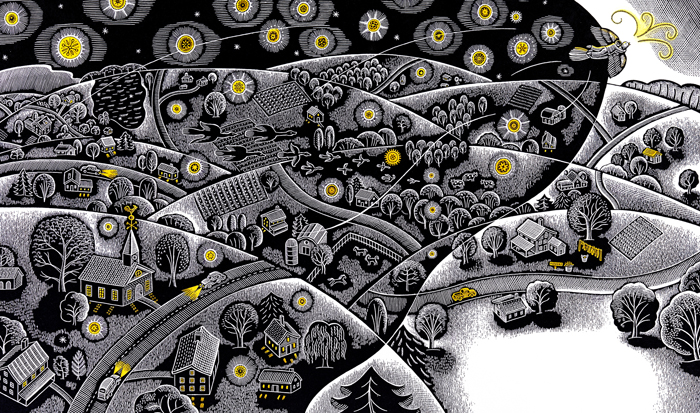
            Another masterpiece that won the Caldecott Award in 2009 is The House in the Night by Susan Marie Swanson, and illustrations by Beth Krommes. This book is truly a visual experience. The artwork is done in a limited palette just using the page color and black ink with splashes of yellow color. Still another illustration technique is used in this piece as well. The etching style of illustration is a completely different style than the previous 4 awarded books. The artist uses hatching techniques to create rather involved landscapes with a rather long visual field considering the technique. A very small sentence or phrase on the page guides the reader as they gaze at the elaborate monochromatic texture before them. Consider the complex illustration below where the text simply reads, “the house in the night” (Swanson, 2008).
Source: http://blaine.org/sevenimpossiblethings/?p=2206
With imagery as such a key element in picture book literature, we can appreciate the standards that the Caldecott Medal recognizes and ensures in children's literature. The award proves that the expectation and standard remain paramount in quality pieces for children’s literature. At the same time we also see that the Caldecott is not in any way committing to one style of illustration over another, but rather celebrating creative and progressive works that directly correlate with the story line and push the message of the text forward. The Caldecott Award proves that the creativity and expression created should not go unnoticed as it recognizes the efforts of dedicated authors and illustrators in this industry.

Works Cited:
Bunting, Eve, and David Diaz. Smoky Night. San Diego: Harcourt Brace,
      1994. Print.
Caldecott Medal Picture Books. Web. 03 Dec. 2011.       
      medal-picture-books.blogspot.com/>.
Kennedy, Elizabeth. Caldecott Medal for Illustration of Children's Books - 
     Randolph Caldecott Award Winners. About. Web. 21 Nov. 2011. 
Miller, Linda. Personal interview. 21 Nov. 2011.
Swanson, Susan M., and Beth Krommes. The House in the Night. Houghton
      Mifflin Company, 2008.
Wisniewski, David, and Lee Salsbery. Golem. New York: Clarion, 1996.
      Print.
Van Allsburg, Chris. Jumanji. Boston: Houghton Mifflin, 1981. Print.
Van Allsburg, Chris. The Polar Express. Boston: Houghton Mifflin, 1985.
     Print.

Psychoanalysis of Cinderella,


The Psychoanalysis of Charles Perault and His
Cinderella, or the Little Glass Slipper.

Charles Perault reveals much of his core value, upbringing, personal experiences and
subconscious addenda’s in his work Cinderella, or the Little Glass Slipper
.  The psychoanalysis of this story reveals many details of the life of Charles Perault’s. Further more, Perault uses his writing to help children, but also subconsciously advocates his personal addenda’s from his life experience.
The psychoanalytic approach of looking into an authors writing gives great insight into much of the past experiences and subconscious musings of the writer. With this approach the piece will be examined for details that could “express the secret unconscious desires and anxieties of the author” (Delahoyde, 2011). This analysis is based on the theories, and ideas of “Harold Bloom, Jacques Lacan, Sigmund Freud” (AIO, 2011). Typically when reviewing a story most look to the characters and try to decipher how the author is attempting to express themselves through an individual character. This however is typically not the case in the Psychoanalytic approach as the author is assuming identities in all characters, elements and happenings in story and they are in turn all projections of the writer. As the text is examined the reader searches for key components that point to unresolved emotions, guilt, or conflicts that position a subconscious expression from the writer. Then considering the author’s personal upbringing and traumatic experiences from family, addictions, sexual confusion, and the like stresses that are tucked away in the characters of the piece of literature. This is unpackaged and revealed by using technique of symbolism, condensation, and displacement.
One of the key elements in the psychoanalytic criticism is the analysis is never attempts to identify the author’s underlying intension for the piece. Rather, it is a probing search to find what the author never intended to reveal in their work, the details of their past. The text is evaluated, searched, and scrutinized for the details that are repressed or buried in the subconscious memory the authors mind truly looking to reveal.
Looking at the background of the author Charles Perault, several details are useful as the as the analysis begins. He was born into a wealthy family that lived in Paris, France. He always was looking to gain more knowledge and went to the best schools where he would achieve top rankings in his classes. The most interesting fact about him is that his fairy tales did not come about till the end of his life. “He was almost 70 years old when he wrote his first fairy tales in 1697” (Unknown 1, 2011). Another very critical detail about Perault, is that his wife passed “in 1678” after 6 short years of marriage (Unknown 2, 2011).
In reviewing Cinderella, or the little Glass Sipper, one thing is very evident using the psychological analysis is we see the writer has an understanding of wealth. The story is about kings, balls, hopes and dreams. This indicates that author has experienced this wealthy life. At the same time, he also shows us that he has an understanding of the working class that supports the upper class. He has communicated a definite attitude against those who have had the wealth handed to them, verses those who have had to work for it. It would be easy to see how he has buried himself in the Cinderella character, as he had to go to school and work for his success. He understood the upper class, but also expresses an undertone of disenchantment with those who did not have to work for their status. 
Considering also how the main character Cinderella is treated, it begs the question of the opposition Perault must have faced in being successful in school. Seeing that he has created this character that is so good, yet faces so much opposition points to his great success, and possibly feeling that he never was giving the recognition he truly deserved.
The author also places himself in the character of the Godmother. This is truly what the story is about, his gift to children. Consider his age, and how long it had been since he had experienced the wonder and excitement of his childhood. The Godmother in this story brings the gift of experience to the main character Cinderella. Consider then how Perauslt has placed himself in that character as he has revealed wonder, and excitement to children through his story. 
Another aspect to consider in Cinderella, or the Little Glass Slipper is the hidden addenda in his communication of characters in this story. “His tales were intended to train young girls in how to become ladies” (Unknown 3, 2011). Being raised with the upper class Perauslt learned quickly what a lady was. He admired the true beauty of a woman with class. His story addresses true beauty and attempts to put his values of what it takes to be a beautiful woman. Consider the moral. “Beauty in a woman is a rare treasure that will always be admired. Graciousness, however, is priceless and of even greater value. This is what Cinderella's godmother gave to her when she taught her to behave like a queen. Young women, in the winning of a heart, graciousness is more important than a beautiful hairdo. It is a true gift of the fairies. Without it nothing is possible; with it, one can do anything.” (Lang, 1891).
Taking Perauslt’s projection of a beautiful refined young woman and how they behave a step further, consider how much of his imagination of beautiful young women is represented in his fantasy in his fairytales. Consider his wife dieing at such a young age, and how he used his stories to carry on his idealism of his deceased wife. This technique is a coping mechanism as well as a technique to fulfill his romantic drive.
By using the Psychoanalytic approach to examine the work of Charles Perauslt, it is clear there he is expressing his subconscious messages through the story. These messages give the reader insight about his values, personal views, struggles, childhood and loss in life. These subtle messages in his stories were not an intentional effort, especially as he was writing to young children, but the subtle elements are key indicators of his personal history and life experiences are much of his work. Some might judge Perauslt with revealing these elements in his work, but the truth of the matter is that every writer expresses their deep-rooted emotions and values in their work. After it all it is their life and experiences that have shaped the individual into who they are. With creating and writing Perauslt was bound to reveal himself in his stories. Even if it was not intentional, his values, character, childhood and personal perception made him into the author that was able to write so many classic tales. He could not have written any other way.


Works Cited:

AIO Classroom, Children's Literature | ENG4010 P01. Week 1, Web. 26, November
    2011.

Lang, Andrew, The Blue Fairy Book, 5th ed. (London: Longmans, Green, and Co., 1891),
   
pp. 64-71.

Delahoyde, Michael. Psychoanalytic Criticism. Washington State University - Pullman,
    Washington. Web. 05 Dec. 2011. .

St. Martin’s, VirtuaLit: Critical Approaches. Default. Web. 05 Dec. 2011.
    .

Unknown 2, "Charles Perrault | Fabulous Fairy Tales." Welcome | Fabulous Fairy Tales. 
    Web. 07 Dec. 2011. .

Unknown 1, The Story of Charles Perrault. Perrault Fairy Tales. Web. 06 Dec. 2011.
     .

Unknown 3, "Charles Perrault." Perrault Bio. Web. 06 Dec. 2011.
   
    /WebProject/Bios/Perrault%20Bio.htm>.


The Change From Book To Film


DISCUSS TOPIC:
In what ways does changing the medium (book to film) alter the social commentary?

When a classic children’s story is recreated for film many times elements of the story need to be altered. “Transforming stories from one medium to another or transplanting them from one setting to another involves trade-offs for good or ill.” (Stahl).  When stories are recreated, and retold many times the process involves altering the story.

Many times the medium in which the piece has been observed first sends an expectation of how one would expect to find the piece in other mediums. For me personally remember the many different Dr Seuss stories that I read as a child. The tone, storyline, imagery and voice inflections were so different from the film versions. I found myself to be very disappointed. Especially looking at the new series on PBS Kids, The Cat In The Hat Knows A Lot About That. In the books the cat seemed to be more irresponsible and looking for fun. This new version seems so tame and scaled back. The cat is more concerned about education in each episode compared to just wanting the kids to have fun.

Another very drastic example of this is in the PBS Kids show Super Why.
Each episode takes a classic children’s story and draws conclusions to help children solve their daily problems. Part of the problem solving the show reveals is actually changing the story to solve the problem. While there is so many examples to pull from this show, one simple concept that has been modernized is that Little Red Riding Hood, has been renamed to Red. She also is always wearing skates.

Many times change is necessary in literature works as the culture pushes forward. As film directors pull the classics and recreate many times we see the final product is drastically different, as the story did not lend well to the visual story line. Also consider how small adjustments to a story could simply be a director’s preference and creative expression. A great example of this is in the 1994 Romeo and Juliet remake movie. Much of the classic speech and is used, but the story setting is contemporary. Even the activities of the characters are more matched to modern day. In one scene the two main characters are dropping acid. This was not part of the original, but was an element that seemed to related to the current culture. 

With a progressive culture always looking to change, improve or modernize the classic works of literature, one might question if the works of the greats will be lost with the noise of the new versions. To some point the works of the greats will be lost. I am personally thinking of all the stories I thought I knew before I took this class. In reading the older versions I have found that I did not ever know the original story. But when we consider how today information is at our fingertips, it is not far fetched to research and find appreciation for the classic work. As it was mentioned in the beginning of this class, many times the hype from a new released story in a new medium creates hype to make the story popular once again. It is just an old product that has been remarketed and branded to a new target group.

Works Cited:
Stahl, J. D., Tina L. Hanlon, and Elizabeth Lennox Keyser. Crosscurrents of
       Children's Literature: an Anthology of Texts and Criticism. New York:
       Oxford UP, 2007. Print.

Resources:

AIO Classroom, Children's Literature | ENG4010 P01. Week 6, Web. 08 December 2011.

Mr. Popper’s Penguins, The Book VS. The Film.


DISCUSS TOPIC:
Please select a story which has been made into a movie and research into its production. Investigate to see if you can find out whose idea it was to create the movie, what ideas guided the production, and so on. Be sure that you cite this information.


As a young child, I had heard and loved the story of Mr. Popper’s Penguins. I can still recall the story written by Richard and Florence Atwater about a house painter and his very entertaining penguins. The book was written in 1938 and was awarded with the Newbery Award. The plot expressed and contained a very unique story about “the adventures of a housepainter and his brood of high-stepping penguins” (Unknown, 2011).  The classic piece became very popular over the years for young elementary students. In 2011 the story was taken and made into a film. While both the book and film have similar concepts, and ideas, and characters when the story was recreated for film many aspects of the story were changed. 

In 2011 Twentieth Century Fox Home Entertainment released their modernized film of Mr. Popper’s Penguins. This new release featured drastically changed the unique family story. From character relationships, values, careers and even the setting of the story has a drastic contrast as the book is compared to the film.

This classic tale took quite a twist when it hit the big screen. The main character is portrayed quit differently in the two different mediums. “The Mr. Popper of the movie is not the carefree, slightly eccentric Mr. Popper of the book” (Wendy, 2011). Looking at the main character, Jim Carey, it is fairly simple to have a good idea of how this character is portrayed in the film. Carey has earned himself quite a reputation for his silly faces, and comical combinations. Considering other movies like, Ace Ventura, Liar, Liar, The Mask, Dumb and Dumber, Yes Man, Bruce Almighty, Me, Myself & Irene and even Batman Forever have all pushed Carey forward with unique yet similar characters that have made Carey into what he is today. Despite Carey’s extreme success in his film career, knowing how his characters are always over-the-top which in turn puts a different spin on this classic tale. We can see how the film chose to rely on the personality of the actor and their entertaining qualities, rather than the quirky characteristics. The book was driven from its entertaining story and well developed characters. 

Looking into the film story we see how the story has been modernized to out current culture. The classic tale sets the story in a fictional small town where the Popper family all live together. The film has a drastically different setting as it is places the story in New York City, and the Poppers have a typical divorced American family. In addition to this detail, the book puts Mr. Popper in a humble job as a house painter. When Hollywood got a hold of the storyline they made some major adjustments to Mr. Popper’s life, as in their version he is a very successful businessman who “has little time for family” (Wendy, 2011).

Another major change in the storyline is the origin of the penguins. The classic tale paints the picture of Mr. Popper’s sense of adventure and how he longs to explore the south pole.  Explorer “Admiral Drake” sends Mr. Popper penguins as a gift (Unknown, 2011). The new film version ties in some issues with Mr. Poppers father that he is carrying over from his childhood. He then acquires these penguins as a gift from his father.  

Overall both the book and the movie are fun and amusing. But if the viewer is planning on the film following the classic story written in text, they will instead find “a very loose interpretation of the book” (Wendy, 2011).  When it comes to a better message to children and their families, it is clear that the classic story shows more character and better values than the new fling. Adapting a classic story to fit better with our modern culture might make it more believable, and easier to related to, but at the same time can pull away many key elements that made the story a classic in the first place.

Works Cited:
Wendy. "Mr. Popper’s Penguins – Book and Movie Review – Caribousmom." Caribousmom. Web. 09 Dec. 2011. .

Unknown, "Mr. Popper's Penguins | Scholastic.com." Scholastic | Children's Books and Book Club | Scholastic.com. Web. 09 Dec. 2011. .

5/22/11

SWF File Format


Using an “Adobe Flash Player and Adobe Air Software” SWF files carry text, videos, vector graphics, and sound to millions viewers over the world wide web (SWF Technology Center, 2011).  It was designed specifically to “deliver graphics and animation over the Internet” (A Concise Guide to the SWF File Format, 2011). With a high compatibility rate of  “ over 98%” with web enable desktop computers, and over “800 million” personal handheld devices, the SWF file format has proved to be a very efficient an effective way to exchange this binary data (SWF Technology Center, 2011).

While the format is extremely useful for displaying the binary information, SWF does not offer editing capabilities, which forces creators and editors to keep the original document in a different format. At the same time, the inability to edit SWF files, serves somewhat as security for the files that have been created.

The format was created with a handful of key goals in mind. The creators knew the importance of having a file created primarily for on-screen display. The on-screen display would then need to offer “fast rendering to a bitmap of any color format, animation and interactive buttons” (A Concise Guide to the SWF File Format, 2011). It also needed to be expandable so it could easily evolve with technology and demand, as well as, maintain compatibility. There was careful consideration placed in the ability to have files compressed for quick loading regardless of the speed, and bandwidth, as well as, then ensure high quality of the viewed information. Having files that were no longer dependent on other external source files was also very important. This removed the concern for linking external files like fonts, source graphics, videos or even sound. Everything would be contained with in the SWF file. Finally the other area development considered is how the file would interact with different sized displays. With continually changing resolutions, screen sizes and shapes it was important to make the file format scalable.


Works Cited.

"A Concise Guide to the SWF File Format." The Labs: Homepage. Web. 22 May 2011. .

"SWF Technology Center | Adobe Developer Connection." Adobe. Web. 22 May 2011. .